
Nag Champa: The Story Behind the World’s Most Beloved Incense
Close your eyes and breathe deeply. That distinctive aroma—earthy yet sweet, floral yet grounding, complex yet somehow utterly familiar—that’s Nag Champa. If you’ve ever walked into a yoga studio, meditation space, spiritual shop, or even a friend’s incense-loving apartment, you’ve almost certainly encountered this iconic fragrance. Its rich, calming scent is so instantly recognizable that a single whiff can transport you to a place of peace, even if you’ve never consciously noticed it before.
But Nag Champa is far more than just a pleasant smell. It’s a piece of living cultural heritage, an aromatic bridge spanning thousands of years and connecting ancient Indian spiritual traditions with modern mindful living practices worldwide. From sacred temple rituals in rural India to contemporary meditation rooms in New York, London, and Tokyo, Nag Champa has achieved something remarkable: it has become the world’s most universally recognized and beloved incense, transcending cultural boundaries while maintaining its spiritual essence.
What makes this particular incense so special? Why has it endured when countless other fragrances have come and gone? How did a traditional Indian temple offering become the go-to scent for spiritual seekers across the globe? The answers reveal a fascinating story of ancient wisdom, cultural exchange, and the universal human longing for peace, connection, and sacred space.
In this comprehensive guide, you’ll discover everything about Nag Champa: its ancient origins in Indian spirituality, the sacred ingredients that create its distinctive aroma, how it traveled from local tradition to global phenomenon, its profound benefits for meditation and wellbeing, proper burning techniques, how to combine it with other spiritual practices, and answers to common questions. Whether you’re a longtime devotee or curious newcomer, understanding Nag Champa’s story will deepen your appreciation for this timeless fragrance and enhance your experience of its transformative power.
What Is Nag Champa? Understanding the Sacred Blend
Nag Champa is a traditional hand-rolled incense originating from India, distinguished by its unique, complex fragrance profile that combines earthy, sweet, and floral notes in perfect harmony. Unlike single-note incenses that feature just one dominant scent, Nag Champa is a sophisticated blend of multiple natural ingredients, each contributing specific aromatic and spiritual properties to create its signature scent.
The name itself offers clues to its composition: “Nag” refers to the nagkeshar tree (Mesua ferrea), whose flowers contribute to the blend, while “Champa” refers to the champa flower (Magnolia champaca or Plumeria), a sacred bloom revered throughout South and Southeast Asia. However, the complete Nag Champa formula includes several other crucial components that together create the full aromatic experience.
The Sacred Ingredients
Halmaddi Resin – The Foundation: The most distinctive and essential ingredient in authentic Nag Champa is halmaddi (sometimes spelled “halmadi”), a natural resin harvested from the Ailanthus malabarica tree, also known as the Indian tree-of-heaven. This sticky, honey-like resin gives Nag Champa its characteristic slow-burning quality, sweet base note, and the slightly damp, earthy undertone that distinguishes it from other incenses. Halmaddi is increasingly rare and expensive, which is why truly authentic Nag Champa commands higher prices than mass-produced imitations.
Champa Flower – The Heart: The champa flower provides the floral middle note that softens the earthiness and adds a gentle, meditative sweetness. In Indian culture, champa flowers are deeply sacred, often offered to deities in temple worship and associated with divine feminine energy.
Sandalwood – The Soul: Indian sandalwood (Santalum album) contributes warm, woody notes and carries its own profound spiritual significance. Sandalwood has been used in Indian spiritual practices for over 4,000 years for its calming, consciousness-elevating properties. Its presence in Nag Champa enhances the blend’s meditative and grounding qualities.
Other Natural Components: Traditional Nag Champa formulas may also include:
- Benzoin resin for sweet, vanilla-like undertones
- Various essential oils for complexity
- Natural gums and wood powders as binders
- Sometimes patchouli for earthiness
- Occasionally hints of jasmine or rose
Each manufacturer guards their exact formula as a closely held secret, passed down through generations. This is why Nag Champa from different producers varies slightly—each represents a family’s unique interpretation of this traditional blend.
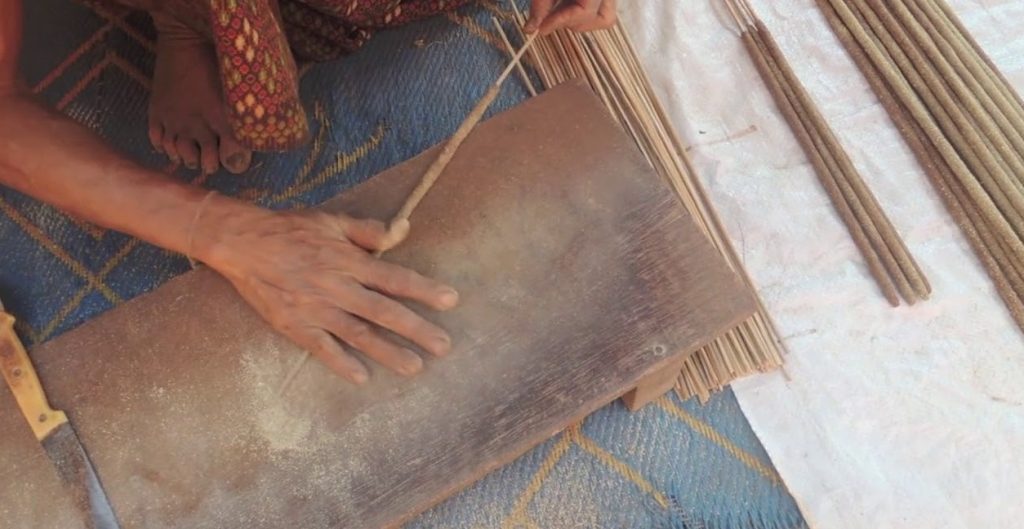
How Traditional Nag Champa Is Made
Authentic Nag Champa follows ancient hand-rolling techniques that remain largely unchanged over centuries:
- Creating the masala (paste): Natural ingredients are ground into fine powder, mixed with water and halmaddi resin to form a sticky paste
- Rolling: Skilled artisans hand-roll this paste onto bamboo sticks, ensuring even coverage
- Drying: Incense sticks dry slowly in the shade (never direct sun) for several days
- Quality control: Each stick is inspected before packaging
This labor-intensive traditional method stands in stark contrast to modern mass-production techniques that use synthetic fragrances, dipping methods, and chemical accelerants. The difference is immediately apparent in burning quality—authentic Nag Champa burns slowly and evenly, releasing fragrance gradually, while cheap imitations burn quickly with harsh smoke and chemical odors.
Ancient Origins: Nag Champa’s Sacred Roots in Indian Spirituality
To understand Nag Champa is to understand the profound role incense has played in Indian spiritual life for millennia. Incense burning in India isn’t merely about creating pleasant aromas—it’s sacred technology developed over thousands of years to purify spaces, honor the divine, focus consciousness, and mark the boundary between ordinary and sacred time.
Incense in Ancient Indian Tradition
Archaeological evidence shows that Indians have been burning aromatic substances for at least 5,000 years, with references to incense appearing in the ancient Vedic texts (1500-500 BCE). The Sanskrit word for incense, “dhūpa,” appears throughout sacred literature, always in contexts of worship, purification, and spiritual transformation.
In Hindu temples, incense serves multiple sacred functions:
Honoring Deities: Burning incense is one of the five essential offerings (panchopachar) made during puja (worship). The fragrant smoke carries prayers and devotion upward to the gods, creating a tangible connection between human and divine realms.
Purifying Space: Sacred smoke cleanses both physical air and subtle energetic atmospheres, preparing spaces for divine presence. This parallels the sage smudging traditions of other cultures, though with distinct aromatic and cultural characteristics.
Marking Sacred Time: The act of lighting incense signals transition from ordinary consciousness to sacred awareness, helping practitioners shift mental states and enter meditation or prayer with focused intention.
Pleasing the Senses: In tantric philosophy, engaging the senses beautifully—through sight (altar decorations), sound (bells and mantras), touch (ritual objects), taste (prasad offerings), and smell (incense)—elevates consciousness and honors the divine nature of embodied existence.
Nag Champa in Temple and Home
While the exact origins of the specific Nag Champa blend are difficult to pinpoint precisely, it evolved within this rich context of Indian incense tradition, likely emerging several centuries ago as temple priests and incense makers refined formulas to create fragrances that particularly enhanced meditation and devotional practice.
Traditionally, Nag Champa was used in:
- Temple worship: During daily pujas and special ceremonies
- Home altars: For personal devotional practice
- Meditation: To create conducive atmosphere for spiritual practice
- Ayurvedic healing: As aromatherapy supporting mental and emotional balance
- Yoga practice: Enhancing the sacred nature of asana and pranayama
The blend’s popularity within India grew because it successfully balanced multiple qualities: complex enough to maintain interest during long meditation sessions, calming enough to quiet mental chatter, sacred enough for temple use, yet accessible enough for daily home practice.
From Sacred Tradition to Global Phenomenon
Nag Champa’s journey from regional Indian incense to worldwide icon represents one of the most successful examples of spiritual practice crossing cultural boundaries. This transformation didn’t happen overnight—it unfolded across decades through several interconnected cultural movements.
The 1960s-70s: Seeds of Western Interest
The first wave of Western Nag Champa adoption came during the 1960s and 70s counterculture movement, when young people in Europe and America began exploring Eastern spirituality as an alternative to Western materialism. The Beatles’ famous visit to India in 1968 to study with Maharishi Mahesh Yogi symbolized and accelerated this trend.
Travelers on the “hippie trail”—the overland route from Europe through Turkey, Iran, Afghanistan, Pakistan, and into India—brought Nag Champa back as authentic souvenirs of spiritual seeking. Head shops, newly opened to serve countercultural communities, began stocking this exotic incense alongside other Indian imports.
But Nag Champa’s appeal went beyond novelty. Unlike some incenses that smelled beautiful but created harsh smoke, or others that were pleasant but forgettable, Nag Champa offered something unique: a complex, sophisticated fragrance that genuinely enhanced meditation and created palpable shifts in room atmosphere. Word spread organically through spiritual communities.
The 1980s-90s: Yoga and Meditation Go Mainstream
As yoga evolved from niche practice to mainstream wellness phenomenon during the 1980s and 90s, Nag Champa came along for the ride. Yoga studios opening across Western cities almost universally adopted Nag Champa as their signature scent. The fragrance became so strongly associated with yoga practice that it triggered Pavlovian relaxation responses—students would smell Nag Champa and immediately feel their bodies preparing for practice.
During this period, Satya Sai Baba Nag Champa, produced by the Shrinivas Sugandhalaya company, became the dominant global brand. Their distinctive blue box became iconic, so widely recognized that “Satya” and “Nag Champa” became nearly synonymous for many Western consumers.
The 2000s-Present: Universal Sacred Scent
By the 21st century, Nag Champa had transcended its exotic origins to become a universal signifier of mindful living. It appeared in:
- Meditation centers and Buddhist temples
- Massage therapy and healing spaces
- Alternative medicine clinics
- College dorm rooms of spiritually curious students
- Urban apartments of wellness-focused professionals
- Retreat centers and spiritual communities
Interestingly, Nag Champa’s popularity in the West has circled back to influence incense use in India itself, where it has become even more prominent as Indians recognize global appreciation for their traditional crafts.
Cultural Appreciation vs. Appropriation
Nag Champa’s global success raises important questions about cultural exchange. Is Western use of this traditional Indian incense appreciation or appropriation? Most spiritual teachers and Indian incense makers welcome the global spread, viewing it as genuine appreciation that supports traditional craftspeople and spreads the calming benefits of this sacred practice. The key is approaching Nag Champa with respect for its origins, purchasing from authentic sources that support Indian artisans, and understanding its place in Indian spiritual tradition rather than treating it as merely exotic fragrance.
Why Nag Champa Endures: The Unique Appeal
Countless incense varieties exist worldwide, yet Nag Champa has achieved unparalleled global recognition. What explains its enduring appeal across cultures and generations?
Complex, Multi-Layered Aroma
Unlike single-note incenses—pure sandalwood, lavender, or jasmine—Nag Champa offers aromatic complexity that engages attention without overwhelming. The fragrance unfolds in layers:
Top notes: Sweet, slightly floral opening
Heart notes: Earthy, resinous depth
Base notes: Warm, woody grounding
This complexity prevents olfactory fatigue. You can burn Nag Champa daily without it becoming boring or cloying—the nose discovers new nuances with each encounter. The blend achieves perfect balance: earthy yet sweet, bright yet grounded, exotic yet somehow familiar.
Genuine Therapeutic Properties
Beyond pleasant fragrance, Nag Champa demonstrates measurable effects on consciousness and wellbeing:
Stress Reduction: The aroma triggers parasympathetic nervous system activation, promoting relaxation and reducing cortisol levels. Many practitioners report feeling noticeably calmer within minutes of lighting Nag Champa.
Meditation Enhancement: The scent helps quiet mental chatter and facilitates the relaxed-yet-alert state ideal for meditation. Like amethyst for crystal meditation, Nag Champa becomes a reliable tool for dropping into deeper states.
Mood Elevation: Natural aromatherapy compounds in authentic Nag Champa gently lift mood and ease anxiety without sedating or energizing excessively. It creates centered calm rather than spacey detachment.
Sleep Support: Burned 30-60 minutes before bed, Nag Champa helps transition from day’s activity to night’s rest, signaling your nervous system that it’s time to wind down.
Cultural and Spiritual Resonance
Nag Champa carries something intangible yet profound: the energetic signature of centuries of spiritual practice. When you burn authentic Nag Champa created through traditional methods by practitioners who understand its sacred purpose, you’re connecting with an unbroken lineage of devotion, meditation, and consciousness exploration.
This isn’t mystical thinking—it’s recognizing that objects created with care, intention, and spiritual awareness carry different quality than mass-produced alternatives. The incense-makers’ state of consciousness while crafting Nag Champa influences the final product, just as a crystal grid built with clear intention works differently than one assembled mechanically.
Universal Yet Personal
Remarkably, Nag Champa appeals across belief systems and spiritual orientations. Hindus, Buddhists, yogis, meditation practitioners, Wiccans, secular mindfulness enthusiasts, and people with no specific spiritual practice all find value in its fragrance. It’s universal enough to feel welcoming rather than sectarian, yet distinctive enough to maintain character.
Simultaneously, Nag Champa becomes deeply personal for regular users. The scent interweaves with your spiritual journey, becoming associated with breakthrough meditations, peaceful evenings, significant realizations, and quiet moments of connection. Over time, it accumulates personal meaning that amplifies its effects.
How to Use Nag Champa: Practical Guidance
Burning Nag Champa correctly ensures optimal fragrance, safety, and spiritual benefits. Here’s comprehensive guidance for various applications:
Basic Burning Instructions
- Choose proper holder: Use an incense holder, ash catcher, or fireproof dish filled with sand. The holder should catch all ash safely and support the stick at proper angle.
- Light correctly: Hold the coated end (not the bamboo stick end) at 45-degree angle. Apply flame until the tip glows red. Let it burn for 5-10 seconds.
- Extinguish flame: Gently blow out the flame or wave stick in air. You want smoldering ember producing steady smoke, not active fire.
- Place in holder: Insert bamboo end into holder. Ensure it’s stable and ash will fall into catcher.
- Monitor: Never leave burning incense unattended. Keep away from flammable materials, drafts, pets, and children.
- Ventilation: While you want the fragrance to fill your space, ensure adequate ventilation. Crack a window slightly to prevent smoke buildup.
For Meditation and Spiritual Practice
Pre-meditation ritual:
- Light Nag Champa 5-10 minutes before beginning meditation to allow fragrance to fill space
- As you light it, set your intention for practice
- The act of lighting becomes part of your ritual, signaling to your subconscious that meditation time begins
- Use the same incense for each session to build Pavlovian association between scent and meditative states
During practice:
- Position incense where you can see smoke rising—this provides visual focal point for meditation
- Use smoke as breath awareness anchor: watch it rise and fall as you breathe
- If mind wanders, return attention to the scent
- The slow-burning quality of authentic Nag Champa means one stick typically lasts 45-60 minutes—perfect for extended practice
Combine with other practices: burn Nag Champa while working with pendulum for enhanced intuitive clarity, during crystal meditation, or after sage cleansing to invite positive energy into freshly cleared space.
For Yoga Practice
Most yoga studios burn Nag Champa before classes begin, allowing fragrance to establish sacred atmosphere without overwhelming students during pranayama (breathwork). For home practice:
- Light 15 minutes before practice starts
- Position where smoke won’t blow directly into your face during poses
- If you have respiratory sensitivity, burn in adjacent room with door open
- The grounding quality particularly supports floor-based yin yoga, restorative practice, and savasana
For Sleep and Relaxation
Nag Champa creates beautiful bedtime ritual:
- Burn 30-60 minutes before sleep, extinguishing completely before getting into bed
- The wind-down routine signals your nervous system that rest approaches
- Pair with other sleep preparation: dimming lights, putting away devices, changing into sleepwear
- Combine with lavender essential oil diffusion for even more powerful sleep support
- Place calming amethyst on nightstand to complete your sleep sanctuary
For Space Clearing and Energy Work
While sage smudging removes negative energy, Nag Champa invites and maintains positive energy. Use it:
- After cleansing: Smudge first with sage to clear, then burn Nag Champa to fill the space with high-vibration energy
- In healing spaces: Therapists, energy healers, and bodyworkers use Nag Champa to maintain peaceful atmosphere between clients
- For daily maintenance: Regular burning prevents energetic stagnation, like regular physical cleaning prevents dust buildup
- In sacred spaces: Altars, meditation rooms, and spiritual practice areas benefit from daily or weekly Nag Champa
For Creative Work and Focus
Many writers, artists, and creative professionals burn Nag Champa while working. Its calming yet focusing effect helps enter flow states:
- Light at the beginning of creative sessions
- The ritual marks transition from ordinary activity to creative work
- The fragrance becomes associated with productivity and inspiration
- Unlike stimulating scents that can create anxiety, Nag Champa provides calm focus
Combining with Other Spiritual Tools
Nag Champa synergizes beautifully with other practices:
- With other incenses: Layer with frankincense for spiritual deepening or sandalwood for extra grounding
- With crystals: The smoke can cleanse and charge your crystal collection
- With sound: Burn during singing bowl practice or mantra chanting
- With essential oils: Diffuse complementary oils like sandalwood or frankincense while burning Nag Champa
Different Types and Qualities of Nag Champa
Not all Nag Champa is created equal. Understanding quality differences helps you choose wisely and avoid disappointing imitations.
Authentic vs. Synthetic
Authentic Nag Champa indicators:
- Contains real halmaddi resin (slightly sticky to touch before burning)
- Hand-rolled in India using traditional methods
- Burns slowly and evenly for 45-60 minutes per stick
- Produces gentle, aromatic smoke without harsh chemical smell
- Leaves minimal ash that’s fine and grey
- Costs more—quality ingredients and traditional craftsmanship aren’t cheap
- Often comes in distinctive traditional packaging
Synthetic/low-quality warning signs:
- Extremely cheap (if it seems too good to be true, it is)
- Burns very quickly (20-30 minutes or less)
- Produces harsh, acrid smoke that irritates throat
- Smells chemical or artificial
- Very hard and dry (no halmaddi resin)
- Leaves chunky, black ash
- Generic packaging or obvious knockoff brands
Popular Authentic Brands
Satya Sai Baba (Shrinivas Sugandhalaya): The most recognized globally. Their blue box is iconic. Consistently good quality, widely available, reasonably priced. This is the “standard” most people know.
Goloka: Another reputable Indian manufacturer. Some prefer Goloka’s slightly sweeter, more floral interpretation. Known for fair trade and charitable business practices.
Hem: Large manufacturer with decent quality at lower price points. Less expensive than Satya but still authentic incense.
Cycle: Premium brand with very high halmaddi content. More expensive but exceptionally high quality. Slow-burning and richly aromatic.
Nag Champa Variations
While traditional Nag Champa follows classic formulas, manufacturers have created variations:
Super Hit: Sweeter, more intense version of Nag Champa. Less earthy, more floral. Very popular alternative.
Sunrise/Sunset: Variations with slightly different aromatic profiles—Sunrise brighter, Sunset mellower.
Dhoop cones: Coneless Nag Champa in cone form for shorter burning time (15-20 minutes).
Nag Champa + other scents: Some brands blend Nag Champa with additional fragrances like lavender, rose, or jasmine.
Where to Buy Authentic Nag Champa
Purchase from:
- Reputable spiritual/metaphysical shops like Alchemy Wares
- Established online retailers specializing in authentic Indian products
- Yoga studios that sell supplies
- Fair trade import shops
Avoid:
- Gas stations and convenience stores (usually synthetic knockoffs)
- Unrealistically cheap bulk deals online
- Sellers who can’t identify manufacturer or origin
Safety Considerations
While Nag Champa is generally safe, follow these precautions:
Fire Safety:
- Never leave burning incense unattended
- Keep away from curtains, papers, bedding, and flammable materials
- Use proper holder that catches all ash
- Ensure it won’t tip over (pets, wind, unstable surfaces)
- Fully extinguish before leaving room or sleeping
Respiratory Health:
- Ensure adequate ventilation—crack a window
- If you have asthma or COPD, consult your doctor before regular incense use
- Don’t burn in small, enclosed spaces without air flow
- Quality matters—synthetic incense releases more harmful particles than authentic natural incense
- If smoke irritates, try essential oil alternatives
Around Children and Pets:
- Keep out of reach of small children
- Never burn in nurseries or children’s rooms while they sleep
- Birds are extremely sensitive to smoke—never burn near them
- Allow pets to leave rooms where incense burns if they choose
FAQs About Nag Champa
What does Nag Champa smell like exactly?
Nag Champa has a complex, multi-layered fragrance that’s difficult to describe to someone who’s never smelled it. The dominant notes are sweet, earthy, and slightly floral, with woody undertones. Imagine a blend of sandalwood, magnolia flowers, and tree resin with subtle powdery sweetness. It’s warm without being spicy, grounding without being heavy, and sweet without being cloying. The scent is rich and slightly mysterious—many describe it as “spiritual” or “meditative” because it immediately evokes calm and sacred space. If you’ve smelled it, you’ll never forget it; if you haven’t, you really need to experience it directly to understand its distinctive character.
Is Nag Champa the same as sandalwood?
No, though they’re related. Sandalwood is a single-note incense made from one ingredient—sandalwood wood or oil. Nag Champa is a complex blend that includes sandalwood as one component along with halmaddi resin, champa flowers, and other ingredients. Sandalwood smells woody, warm, and creamy with a slightly sweet, milky quality. Nag Champa incorporates sandalwood’s qualities but adds floral and resinous notes that create something more complex and multifaceted. If you like one, you’ll probably appreciate the other, but they’re distinctly different fragrances. Think of it like comparing a single instrument to an orchestra—sandalwood is beautiful alone, but Nag Champa is an ensemble.
Why is authentic Nag Champa sometimes sticky or damp feeling?
This is actually a sign of quality, not defect! The stickiness comes from halmaddi resin, an essential ingredient in authentic Nag Champa. This natural resin is slightly tacky and gives the incense its characteristic slow-burning quality and sweet undertone. Cheap synthetic versions use no halmaddi (it’s expensive and increasingly rare), making them completely dry and hard. If your Nag Champa feels slightly soft or sticky to touch before burning, especially in humid conditions, that’s good—it means you have the real thing. Just store it in a cool, dry place to prevent excessive moisture absorption. If it seems very wet or moldy, that’s different and indicates a storage problem.
Can I burn Nag Champa every day, or is it bad for my health?
Daily Nag Champa use in moderation with proper ventilation is generally safe for most people. The key factors are: (1) Ensure adequate air circulation—always crack a window. (2) Use authentic, natural Nag Champa rather than synthetic versions which produce more potentially harmful particulates. (3) Don’t burn continuously for hours—one stick in the morning or evening is plenty. (4) If you have respiratory conditions like asthma or COPD, consult your doctor first. Some studies suggest that long-term exposure to any smoke carries risks, so balance use with common sense. Many yoga teachers, meditation practitioners, and spiritual workers have burned Nag Champa daily for decades without issues when following these guidelines. If you’re concerned, alternate incense with essential oil diffusion or other aromatherapy methods.
What’s the spiritual significance of Nag Champa? Does it have specific metaphysical properties?
In traditional Indian spirituality, Nag Champa isn’t just fragrance—it’s a sacred offering and spiritual tool. The smoke is believed to purify spaces energetically, carry prayers upward to the divine, aid meditation by quieting the mind, enhance spiritual awareness and intuition, and create a boundary between ordinary and sacred time/space. Specific properties attributed to Nag Champa include: opening the crown and third eye chakras (similar to amethyst crystal), promoting peace and mental calm, inviting positive energy while transmuting negativity (like sage smudging but gentler), and supporting connection with higher consciousness. Whether you view these as literal metaphysical effects or psychological associations doesn’t matter—the practical result is the same: Nag Champa reliably creates conditions conducive to spiritual practice and inner peace.
How is Nag Champa different from other types of incense?
Several factors distinguish Nag Champa: (1) Complexity: Unlike single-note incenses (lavender, jasmine, sandalwood), Nag Champa blends multiple ingredients creating layered aromatic profile. (2) Halmaddi resin: This ingredient, unique to certain Indian incenses, creates distinctive slow-burning quality and sweet base note. (3) Traditional craftsmanship: Hand-rolled using centuries-old methods passed through generations. (4) Universal appeal: Most incenses have fans and detractors; Nag Champa is unusually universally appreciated across cultures. (5) Spiritual association: Strong connection to meditation, yoga, and spiritual practice gives it meaning beyond fragrance. (6) Consistency: Unlike single botanical incenses whose scent varies by harvest, traditional Nag Champa maintains consistent profile. You can try other sacred incenses like frankincense or sandalwood for variety, but Nag Champa remains the gold standard for many practitioners.
Can I use Nag Champa for the same purposes as sage smudging?
Nag Champa and sage smudging serve complementary but different purposes. Sage is primarily for clearing and removing negative energy—it’s the spiritual equivalent of deep cleaning, stripping away unwanted energetic residue. Nag Champa is more about maintaining positive energy and creating sacred atmosphere—like keeping a space fresh and inviting after cleaning. The ideal approach: First smudge with sage when you need serious clearing (moving into new home, after conflict or illness, before important spiritual work). Then burn Nag Champa to invite positive energy into the freshly cleared space. For ongoing maintenance, alternate: smudge weekly or monthly for deep clearing, burn Nag Champa daily or several times weekly to maintain high vibration. They’re teammates, not competitors—use both as part of your complete energetic hygiene practice along with protective crystals and intention setting.
Final Thoughts: The Timeless Magic of Nag Champa
In a world of constant change, rapid trends, and fleeting fads, Nag Champa endures. This isn’t accidental or arbitrary—it persists because it works. For thousands of years in India and decades globally, people have turned to this distinctive fragrance when they need to shift from chaos to calm, from stress to serenity, from ordinary consciousness to sacred awareness. That track record speaks volumes.
What makes Nag Champa truly remarkable is how it bridges worlds. It connects ancient temple traditions with modern meditation rooms. It links Eastern spiritual wisdom with Western wellness practices. It brings together diverse people—Hindu devotees, Buddhist monks, yoga practitioners, secular mindfulness enthusiasts, and spiritual seekers of all kinds—in shared appreciation for this aromatic experience. In an increasingly fragmented world, anything that creates such universal common ground deserves celebration.
But perhaps Nag Champa’s greatest gift is simpler and more personal than cultural significance or historical legacy. It’s this: when you light a stick of authentic Nag Champa, inhale deeply, and let its rich, complex fragrance fill your awareness, something shifts. Mental chatter quiets, at least a little. Shoulders drop. Breath deepens. The present moment becomes more accessible. Whatever was gripping you loosens its hold, even temporarily. This isn’t mystical or metaphysical—it’s the practical magic of a perfectly crafted aromatic blend meeting your nervous system’s need for peace.
Over time, if you use Nag Champa consistently in your spiritual practice, something even more profound occurs: the fragrance becomes entrained with your deepest spiritual experiences. That scent becomes associated with breakthrough meditations, moments of profound peace, insights that changed your life, and quiet recognition of something greater than your small self. Eventually, lighting Nag Champa doesn’t just smell pleasant—it triggers instant access to those states of consciousness. The fragrance becomes a key that unlocks your spiritual awareness.
This is why longtime practitioners speak of Nag Champa with such affection and loyalty. It’s not just incense—it’s a companion on the journey, a reliable friend who’s been present for your transformation, a constant reminder that peace and connection are always available when you pause to notice. The simple act of lighting that stick becomes a commitment to yourself: for the next hour, I will honor my spiritual nature. I will create sacred space. I will remember what matters.
Whether you’re brand new to Nag Champa or have been burning it for decades, approaching it with fresh appreciation deepens the experience. Understanding its ancient origins reminds you that you’re participating in tradition stretching back millennia. Recognizing the craftsmanship involved honors the hands that rolled each stick. Acknowledging its spiritual purpose elevates casual use into conscious practice. Nag Champa offers you exactly what you bring to it—burn it absently and it’s just nice smell; burn it with intention and reverence, and it becomes portal to the sacred.
In the end, Nag Champa’s story is your story too. It represents the universal human longing for peace, connection, and meaning. It demonstrates that beauty and spirituality can travel across cultural boundaries while maintaining their essence. It proves that ancient wisdom remains relevant in contemporary life. And it shows that simple things—a stick of incense, a moment of intentional breathing, a dedication to inner peace—can transform not just rooms but lives.
The smoke rises. The fragrance fills the space. And for a moment, or an hour, or a lifetime, everything feels a little more sacred, a little more peaceful, a little more connected to something greater. That’s the magic of Nag Champa, and that’s why it endures.
Ready to experience authentic Nag Champa? Explore our collection of traditional hand-rolled Nag Champa and other sacred incenses sourced directly from artisans in India. Create your complete sacred space with cleansing sage bundles, meditation crystals, and pure essential oils. Layer your practice with crystal grids and intuitive guidance tools. Create sacred space. Honor tradition. Transform your practice.