
How To Begin
A Simple Chakra Balancing Practice
Find a quiet space where you will not be disturbed. Sit or lie comfortably with your spine aligned and your hands resting open in your lap.
Begin with three slow, conscious breaths. On each exhale, allow your body to soften. This signals the nervous system that it is safe to open.
Choose a crystal, oil, or incense aligned with the chakra you are working with. Place it nearby or hold it in your hands and allow its energy to come into awareness.
Bring your attention to the location of the chakra in your body. Visualise a sphere of light in its corresponding colour, glowing steadily with each breath.
Silently or aloud, repeat an affirmation aligned with that centre — “I am safe and grounded,” “I give and receive love freely,” “I speak my truth with ease.”
Spend five to ten minutes with each chakra, or focus your entire session on the one that calls most strongly for attention. There is no wrong approach.
Close by returning awareness to your breath, giving thanks, and placing both feet firmly on the floor to ground the energy you have moved.
The Seven Centres
Know Your Energy Body
Root
Safety, grounding, stability
Sacral
Creativity, pleasure, flow
Solar Plexus
Confidence, will, power
Heart
Love, compassion, healing
Throat
Expression, truth, voice
Third Eye
Intuition, clarity, vision
Crown
Consciousness, unity, spirit
Shop the Collection
Chakra Balancing Tools
Products by Category
-

7 Chakra + White Sage 4″ (Copy)
£5.99 -

Ayurvedic Seven Chakra Incense -15g
Price range: £1.50 through £13.99 -
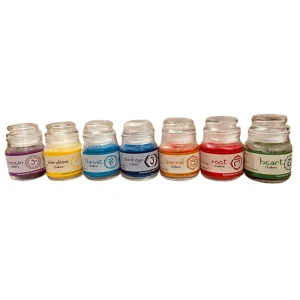
Seven Chakra Balancing Candles
£11.99
Related Practices
Continue Your Journey

Sacred Scent
Aromatherapy
Harness the power of plant medicine to transform your space, shift your mood, and support your daily wellbeing.
Explore Aromatherapy →
Sacred Practice
Meditation
Create sacred space, quiet the mind, and deepen your daily practice with intentionally curated ritual tools.
Explore Meditation →
Sacred Cycles
Lunar Rituals
Align your intentions and your practice with the ancient rhythm of the moon and its eight sacred phases.
Explore Lunar Rituals →Your Practice Essentials
What You’ll Need
Chakra Crystals
Each stone resonates with a specific energy centre. One is enough to begin.
Shop Crystals →
Chakra Oils
Apply to the pulse point nearest your chosen chakra to amplify the work.
Shop Oils →
Chakra Incense
Scent shifts the energetic state of a space instantly and anchors intention.
Shop Incense →
Ritual Kits
Everything you need in one curated set — ideal for beginners and gifting.
Shop Kits →Questions
Frequently Asked
How do I know which chakra needs balancing? +
Common signs of imbalance include physical tension in specific body areas, recurring emotional patterns such as chronic fear, anger, or grief, or persistent life challenges in particular domains. The root relates to security and survival; the sacral to creativity and relationships; the solar plexus to self-esteem and agency. Sit quietly and notice where in your body you feel constriction or heaviness — that is usually a reliable guide.
Which crystals are best for chakra work? +
Each chakra has associated crystals. Red jasper and black tourmaline for the root, carnelian for the sacral, citrine for the solar plexus, rose quartz and green aventurine for the heart, blue lace agate for the throat, amethyst and lapis lazuli for the third eye, and clear quartz or selenite for the crown. Begin with one or two rather than a full set — depth of connection matters more than quantity.
Can essential oils really affect my chakras? +
Scent has a direct neurological pathway to the limbic system — the emotional brain — which means aromatherapy can shift your energetic state very quickly. Grounding oils such as vetiver and cedarwood support the root; rose and ylang ylang open the heart; frankincense and sandalwood elevate consciousness toward the crown. Used with clear intention during chakra work, they amplify and anchor the practice.
How often should I practise chakra balancing? +
A brief daily practice — even five to ten minutes — is more beneficial than a long session once a month. Morning is ideal, before the day’s demands fragment your attention. During periods of stress or transition, daily work with a specific chakra can create meaningful shifts within a week or two.